

Building the capacity of Tribal food producers is integral to the Indigenous Food System Resilience Project’s work to support Tribal food sovereignty in Wisconsin. We are engaged in collaborative, intertribal partnerships that are helping provide the training needed for Tribal producers to succeed, expand their operations, and for new people to become producers.
Central to this work is the Tribal Elder Food Box Program – a catalyst for intertribal collaboration in Wisconsin and the expanding intertribal food sovereignty efforts in the region. The Great Lakes Intertribal Food Coalition and Feeding America Eastern Wisconsin partner to distribute boxes with free, locally produced, culturally appropriate foods to elders from all 11 Federally recognized Tribes in Wisconsin. In 2024, the program distributed over 31,500 boxes filled with $2.1 million of food purchased locally. Beginning with four Tribal producers in 2021, the program has expanded to sourcing from 38 Tribal producers in 2024, now making up 61% of the program’s food budget.
Despite this growth, there are currently not enough Tribal food producers to grow all the food distributed in the Tribal Elder Food Box Program. There is a need to help current Tribal producers expand their capacity and to increase the number of new Tribal producers. To help meet this need, the Indigenous Food Systems Resilience Project is collaborating with the Great Lakes Intertribal Food Coalition, Menominee Department of Agriculture and Food Systems, Ho-Chunk Department of Agriculture, Wisconsin Tribal Conservation Advisory Council, and other partners.


The Indigenous Food Systems Resilience Project brings UW-Madison expertise, support, and resources to coordinate and host workshops and trainings with our partners. Some trainings are stand-alone, such as two tractor safety trainings offered this year. Many are part of a larger series of Indigenous Producer Academies organized by the Great Lakes Intertribal Food Coalition and Menominee Department of Agriculture and Food Systems through their USDA-funded Increasing Land, Capital, Market Access grant.
“The intent of this grant is to build capacity and address capital and market access challenges for producers connected to our intertribal food systems work,” says Dan Cornelius (Oneida), Indigenous Food Systems Resilience Project co-lead and member of the Great Lakes Intertribal Food Coalition Planning Team. “We are doing this in multiple ways, including a train-the-trainer approach, providing technical assistance, and developing other requested trainings that will help advance our Tribal producers.”
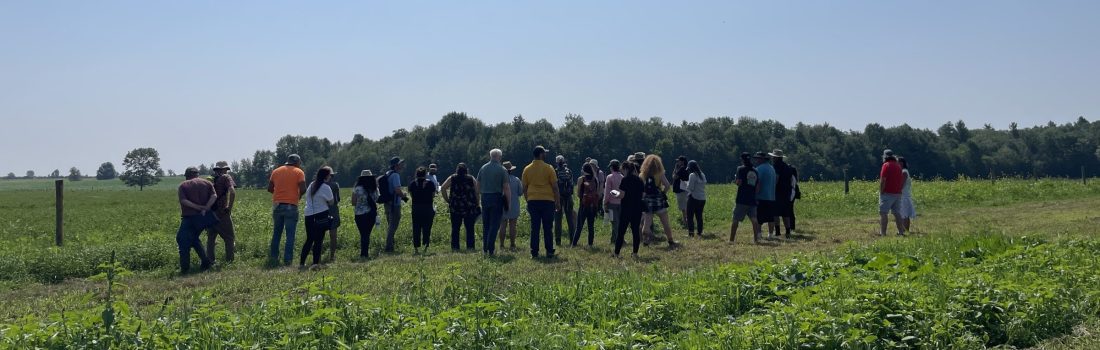
In July 2024, the Great Lakes Intertribal Food Coalition, Wisconsin Tribal Conservation Advisory Council, and UW-Madison partners organized an Indigenous Producer Academy at the Forest County Potawatomi Bodwéwadmi Ktëgan Farm and Menominee Department of Agriculture and Food Systems Floring Farm. The event showcased traditional knowledge and provided training in sustainable farming practices and business development. On the first day, participants toured the Bodwéwadmi Ktëgan Farm and attended sessions about composting, beekeeping, hoop house vegetable production, rotational grazing, and aquaponics. The next day, the group visited the Menominee Department of Agriculture’s Floring Farm and engaged in sessions about developing grazing plans and business planning.
The Indigenous Food Systems Resilience Project Communications Team and videographers joined the event to capture video and interview Tribal producers. They worked with the event organizers to create a video that highlights the impacts of these intertribal efforts. In the video, Tribal producers and partners shared why this work is important to them. Event coordinator and Menominee Department of Agriculture and Food System staff member Jen Falck (Oneida) explained “we love teaching people how to become food sovereign, teaching people that they can do all of these things that look scary, but they’re not.” Hands-on learning opportunities at the Indigenous Producer Academy had a big impact in helping participants feel more comfortable and confident with anything from composting to beekeeping.
This October, a half-day Indigenous Producer Academy was part of the two-day Intertribal Harvest Gathering hosted by the Ho-Chunk Nation in Baraboo, WI. This winter, we are working together with our partners to plan future Indigenous Producer Academies and a full calendar of webinars and trainings for 2026.