

For Ojibwe people, wild rice—manoomin—is far more than a food source. It is a sacred relative, central to culture, identity, and community well‑being. Yet over the past century, manoomin beds in the St. Louis River Estuary near Superior, WI were nearly lost. Only in the last decade, after sustained restoration efforts, has the rice begun to return.
As the rice rebounds, a new question has emerged from Tribal members and local residents: How do contaminants affect the health of restored manoomin and those who eat it?”
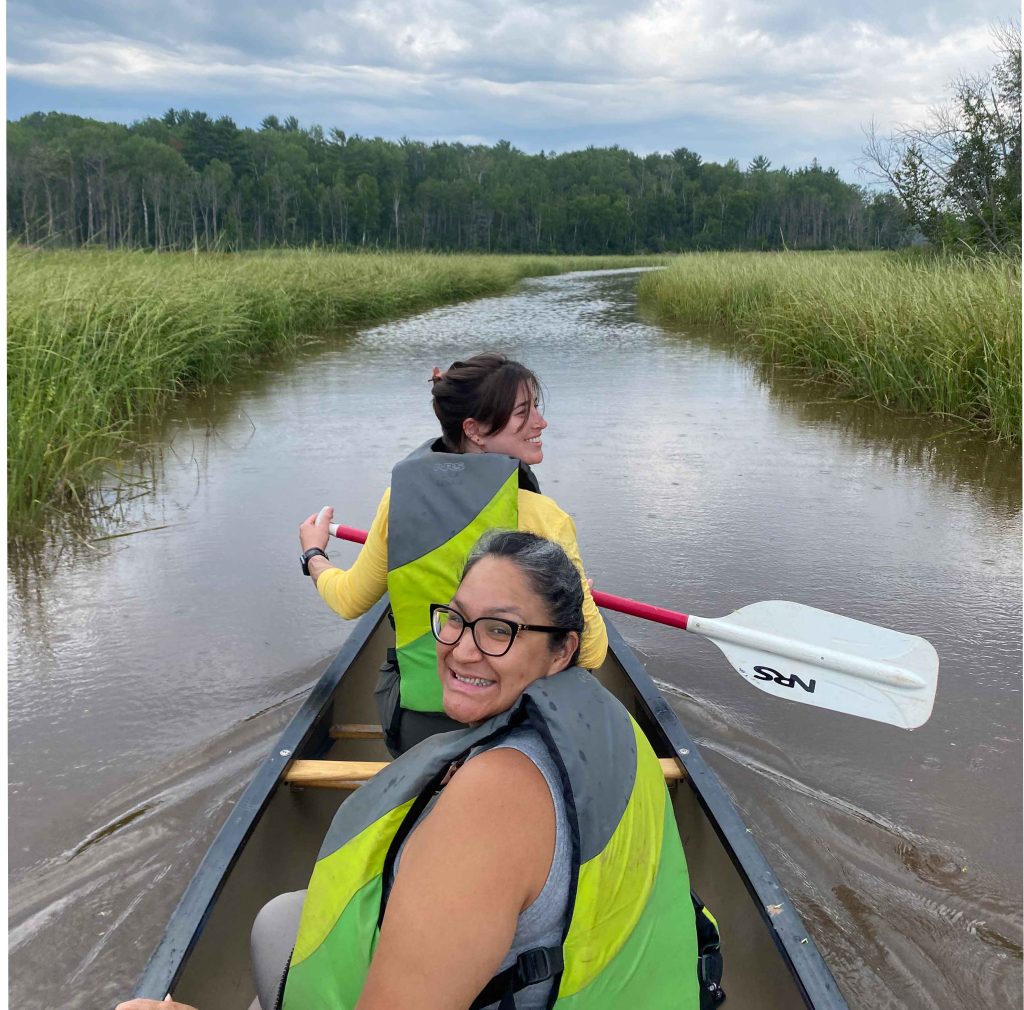
That concern is rooted in lived experience. “The rice disappeared in a lot of places that it used to really grow thick,” says Mark McConnell, an Elder with the Fond du Lac Band of Lake Superior Chippewa. “The elders used to say the rice won’t grow where it’s contaminated. The creator won’t allow it to grow so people harvest it and wind up getting sick. That had always stuck in my head.”
To help answer this question, the Indigenous Food Systems Resilience Project—a collaboration between Tribal Nations, UW–Madison College of Agricultural and Life Sciences, and UW–Madison Extension—launched a multiyear effort to test soil, water, and manoomin plants and seeds for contaminants including heavy metals and PFAS. This work was led by the Lake Superior National Estuarine Research Reserve and the Hua Lab on the UW-Madison campus.
A newly released video from the project team walks viewers through this process, offering an inside look at how researchers and Ojibwe partners have worked side by side over the past two years. The team compared heavy metal levels in parched manoomin from the estuary to published data on white rice. Early findings show that in most cases, manoomin from the St. Louis River Estuary contains lower levels of heavy metals than what has been reported in white rice.
For McConnell, the preliminary results offer hope. “To look at the data that has come from this, it really makes me feel good that things are cleaning up and that it’s safe to eat again,” he says. “And finding the rice coming back in such abundance… it makes me happy.”
The research is ongoing, and the team continues to analyze data and share results directly with Tribal community members and organizations, including the 1854 Treaty Authority, Fond du Lac Band, and the Great Lakes Indian Fish and Wildlife Commission. This work is possible in part because of financial support from the UW–Madison Rural Partnerships Institute, funded by the USDA National Institute for Food and Agriculture. The Rural Partnerships Institute supports community-driven projects and builds partnerships that strengthen rural resilience. This funding allowed for the building of foundations that will enable the team to continue addressing community questions and to work more deeply and meaningfully with Tribal Nations on future food sovereignty projects.
Hear the full story—and the voices of those leading this work—in the project’s new video:
This work is supported by the USDA National Institute of Food and Agriculture. Any opinions, findings, conclusions, or recommendations expressed in this publication are those of the author(s) and should not be construed to represent any official USDA or U.S. Government determination or policy.